


Chemical and process: case studies

CFD simulation of a Continuous Stirred-Tank Reactor

OptiFluides performs CFD simulations of stirred tank reactors, enabling optimization of their design and operation.

Context

In chemical production units, the reactor is often the central element of the process. The term “reactor” itself actually covers a wide variety of different systems: tubes, open or closed tanks, furnaces, columns, boilers, etc. What they have in common is that they enable chemical transformation, and they differ in how they work to achieve this.

Reactors are classified as single-phase or multi-phase (gas/liquid, fluid(s)/solid), batch or continuous, isothermal or adiabatic, tubular or perfectly stirred, among other categories. These reactors are used in the chemical and process industries, as well as in pharmaceuticals, water treatment, cell culture, and biofermentation.

In this example we are looking at a continuous stirred tank reactor. This tank allows a high flow rate of circulating acrylonitrile to come into contact with sulfuric acid.

Acrylonitrile is a liquid monomer that is widely used in the plastics industry, particularly in the manufacture of nylon, synthetic rubber, and ABS (Acrylonitrile Butadiene Styrene).

The sulfuric acid, also in liquid form, is injected from the top of the reactor, causing a jet phenomenon that impacts the free surface of the mixture.

The vessel is also equipped with baffles, which generate an axial/radial mixture.
Objectives

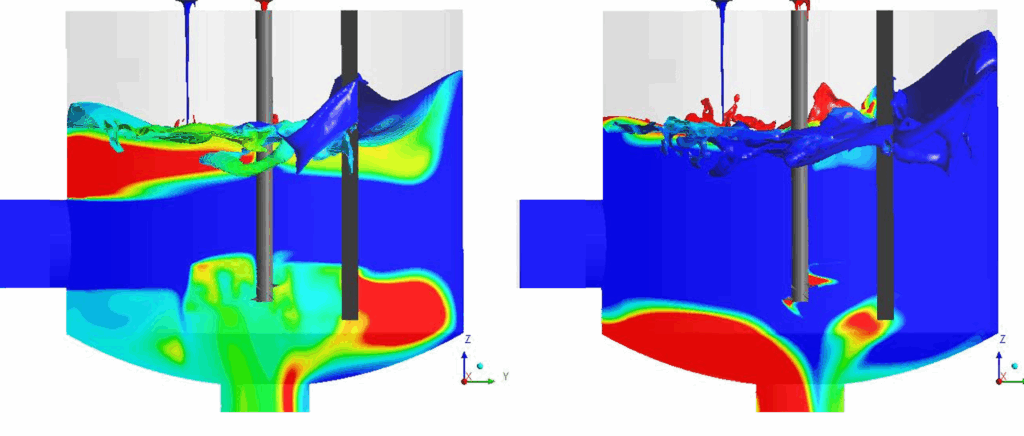
The objective of this study is to compare different operating modes: with or without baffles, with or without agitation, by varying the direction of rotation, or even the position of the sulfuric acid injection and the flow rate.

Simulation CFD d'un réacteur à cuve agitée - concentration en acide sulfurique et surface libre, plan médian du réacteur

CFD simulation of a stirred tank reactor – sulfuric acid concentration and free surface, median plane of the reactor

Simulation and results

The first step is to determine the flow regime in the reactor by calculating two key dimensionless numbers in process engineering: the Reynolds number and the Froude number.

The Reynolds number is calculated as follows:

Re = ρNda2

Where ρ is the fluid density (kg/m³), µ is its dynamic viscosity (Pa·s), N is the rotation speed of the stirring device in revolutions per second (rps), and da is the diameter of the agitator. Note that the thresholds for laminar/turbulent flow differ depending on the type of stirring device:

  • Laminar flow for Re < 10
  • Intermediate flow for 10 < Re < 10n
  • Turbulent flow for Re > 10n
  • With n = 4 for radial discharge impellers and n = 5 for axial discharge impellers.

The Froude number is calculated as follows:

Fr = N2da/g

With g gravitational acceleration.

Its importance is less significant in the case with baffles. Nevertheless, it is here of the order of 3 and reflects the need to take into account the deformation of the free surface, which can be significant.

The modeling is therefore carried out using a stationary, turbulent, two-phase, isothermal, species transport model.

Through these calculations, we sought to identify cases that:

  • Present better spatial homogeneity in the concentration of chemical species at the outlet (better mixing),
  • Also minimize the torque on the shaft (reduction in power consumption).
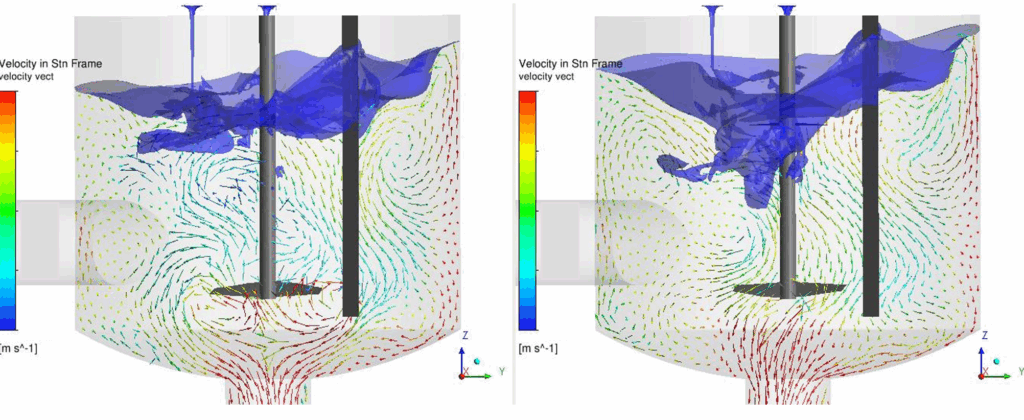
Simulation CFD d'un réacteur à cuve agitée - champ de vitesse dans le plan médian et surface libre

CFD simulation of a stirred tank reactor – velocity field in the median plane and free surface

Optimizing the operation of continuous stirred-tank reactors (CSTRs) can be challenging and particularly costly without modeling: it requires building prototypes, instrumenting them, using consumables, etc. Computational fluid dynamics (CFD) simulation is particularly well suited to these issues: these models are well known and well understood, and allow you to test a large number of configurations at low cost, accurately identify the advantages and weaknesses of each configuration, and thus make informed choices in your stirred tank design or improvement project.

Contact us

To learn more about CFD simulations of stirred tank reactors